logo gwto summit alentejo

Alentejo presents at FITUR 2026 as the venue for the III GWTO Global Summit on Responsible Enotourism

ENG/ESP Press Release/Nota de Prensa.
Madrid, Spain/España.

ENG

The Portuguese region of Alentejo, renowned for its slow tourism philosophy and the quality of its wines, announced at FITUR 2026 that it will host the III GWTO Global Summit on Responsible Enotourism, organized by the Global Wine Tourism Organization (GWTO). This magnum meeting will bring together institutional leaders, experts, and professionals from the sector from around the world in Portugal.

The choice of the region as the venue for the OMET Summit reinforces its strategic positioning, based on low-impact tourism capable of connecting travelers with the Alentejo community.

Alentejo is a vast and mainly rural region. The beauty of its landscape and the quality of its archaeological, monumental, and architectural heritage, together with its excellent cuisine and wines, undoubtedly invite visitors to discover the region.

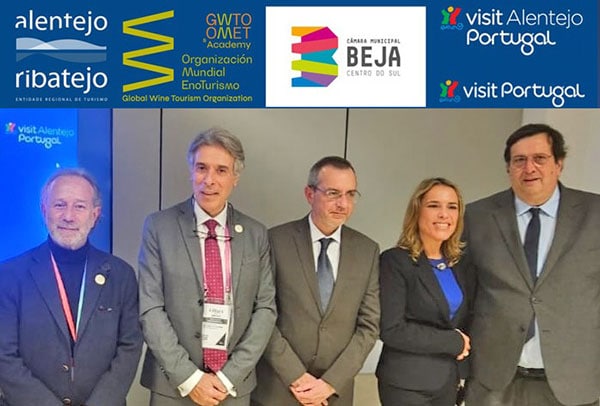
The event was attended by the president of Alentejo Tourism, José Santos, the president of the Global Wine Tourism Organization (GWTO), José Antonio Vidal, and the mayor of Beja, Nuno Palma Ferro.

The International Tourism Fair FITUR has been chosen as the venue to showcase the Alentejo model as a responsible enotourism destination, based on the authenticity of the region, respect for the environment, and local wine-making traditions.

“We are very proud to take another step forward in the recognition of the Alentejo as a enotourism destination committed to a conscious strategy that is deeply respectful of our region. In the Alentejo, wine is the most representative product: it is history, it is tradition, and it is identity,” said José Santos, president of Turismo de Alentejo.

The GWTO Founder and President CEO, José Antonio Vidal, reported that “the GWTOT Global Summits aim to contribute to the positioning of enotourism on the international map, both for emerging destinations and for strengthening those that are already well established.

Punta del Este (Maldonado, Uruguay) and Yantai (Shandong, China) hosted the GWTO Summits in 2024 and 2025, respectively. Beja (Alentejo, Portugal) will host this year’s summit from May 31 to June 3, and Querétaro (Mexico) and Ningxia (China) have submitted their credentials to host the 2027 Summit.

Vidal added that “GWTO Summits are part of its strategic plan, as a whole, for the international positioning and strengthening of destinations.

GWTO MICE promotional campaign complemented by four other lines of action, integrating the five pillars of OMET:

  • Recognition through the international GWTO-OMET Biosphere Certification as an RSS enotourism destination: responsible, sustainable, and satisfying for both visitors and residents.
  • Training in Comprehensive Management of RSS Enotourism (with GWTO Academy in collaboration with local academic institutions).
  • Commercialization, through the inclusion of enotourism activities on the GWTO global enotourism booking platform ‘EWC EnoWineClub: More than Wines’, and
  • Monitoring of destinations and their enotourism resources, contributing data to the ‘GWTO Economic Monitor/Observatory of Global Enotourism’.

Set among vineyards, centuries-old olive groves, and wide plains, the wineries open their doors to visitors, offering experiences that combine tours, tastings, accommodation, and gastronomy, creating a carefully curated wine tourism offering.

alentejo omet

ESP

Alentejo se presenta en FITUR 2026 como sede de la III Cumbre Global OMET de Enoturismo Responsable

La región portuguesa del Alentejo, reconocida por su filosofía de turismo slow y la calidad de sus vinos, ha presentado en FITUR 2026 su nombramiento como próxima anfitriona de la III Cumbre Global OMET de Enoturismo Responsable, organizada por la Organización Mundial del EnoTurismo (OMET). Este encuentro reunirá a líderes institucionales, expertos y profesionales del sector de todo el mundo en el territorio luso.

La elección de la región como sede de la Cumbre OMET refuerza su posicionamiento estratégico, basado en un turismo de bajo impacto capaz de conectar a los viajeros con la comunidad alentejana.

Alentejo es una región extensa y principalmente rural. La belleza de su paisaje y la calidad de su patrimonio arqueológico, monumental y arquitectónico, junto con su excelente gastronomía y sus vinos invitan, sin duda, a descubrir la región.

El acto ha contado con la presencia del presidente de Turismo de Alentejo, José Santos, del presidente de la Organización Mundial del EnoTurismo (OMET-GWTO), José Antonio Vidal, y del alcalde de Beja, Nuno Palma Ferro.

La Feria Internacional del Turismo FITUR ha sido el escenario elegido para poner en valor el modelo del Alentejo como destino enoturístico responsable, basado en la autenticidad del territorio, el respeto por el entorno y la tradición vitivinícola local.

“Estamos muy orgullosos de dar un paso más en el reconocimiento del Alentejo como destino enoturístico comprometido con una estrategia consciente y profundamente respetuosa con nuestro territorio. En el Alentejo, el vino es el producto más representativo: es historia, es tradición y es identidad” ha señalado José Santos, presidente de Turismo de Alentejo.

El Fundador y Presidente CEO de OMET, José Antonio Vidal, informó que “las Cumbres Globales OMET tienen como objetivo colaborar al posicionamiento en el mapa internacional del enoturismo, tanto de los destinos emergentes, como al fortalecimiento de los ya consolidados.

Punta del Este (Maldonado, Uruguay) y Yantai (Shandong, China) fueron sedes de las Cumbres OMET en 2024 y 2025, respectivamente. Beja (Alentejo, Portugal), lo será este año, del 31 de mayo al 3 de junio, y Querétaro (México) y Ningxia (China) aportaron sus credenciales para serlo en 2027”.

Vidal añadió que “las Cumbres OMET se enmarcan dentro de su plan estratégico, como una parte del todo, para el posicionamiento y fortalecimiento internacional de los destinos.

Acción promocional de OMET MICE que se completa con las otras 4 líneas de actuación, integrando los 5 pilares de OMET:

  •  El reconocimiento, a través de la Certificación internacional ‘GWTO-OMET Biosphere’ como destino enoturístico RSS: responsable, sostenible, y satisfactorio tanto para los visitantes como para los residentes.
  • La capacitación en Gestión Integral del Enoturismo RSS (con OMET Academy en colaboración con entidades académicas locales).
  • La comercialización, mediante la inclusión de las actividades enoturísticas  en la plataforma OMET de reservas del enoturismo mundial ‘EWC EnoWineClub: Más que Vinos’, y
  • La monitorización de los destinos y sus recursos enoturísticos, aportando sus datos al  ‘Monitor/Observatorio Económico OMET del Enoturismo Mundial’ ”.

Entre viñedos y olivares centenarios y amplias llanuras, las bodegas abren sus puertas al visitante con experiencias que integran visitas, catas, alojamiento y gastronomía, configurando una oferta enoturística cuidada.

ruta iberica enoturismo

Iberian Enotourism Route / Ruta Ibérica del Enoturismo

ENG/ESP Press Release/Nota de Prensa. 
Santarém (Portugal).

The Iberian Peninsula, cradle of the Eno and Gastronomy Tourism between the Old and the New World.

The initiative arises from the Global Wine Tourism Organization GWTO as a facilitator of building international bridges in favour of positioning destinations and initiatives of high scope in the markets.
Iberian Enotourism Route has the support of the National Enotourism Associations of Spain and Portugal, of the Ibero-American Academy of Gastronomy AIBG for its projection in the New World, of the Spanish-Portuguese Chamber of Commerce for the coordination between companies, and of the world enotourism booking platform EnoWineClub EWC for marketing the experiences.

“AIBG always had a special interest in highlighting the contribution of the Iberian Peninsula in everything related to wine as a fundamental food to complete the gastronomic offer of Ibero-America. There is nothing better than tourism among the rivers and landscapes of both countries to enjoy their gastronomic cultural essence,” said Rafael Ansón, Founding President of AIBG and Founding Honorary President of the International Academy of Gastronomy.

“The project is a clear example of the twinning between two countries through their Spanish (AEE) and the Portuguese (APENO) EnoTourism Associations. Two countries united to boost and emphasize the great richness of their cultural heritage, their history, their art and their wine and gastronomy tradition”, said José Antonio Vidal, Founder President CEO of the Global Wine Tourism Organization (GWTO).

“Entrepreneurs and public sector actors are required to be supportive among ourselves and with the community, collaborating with actions that contribute both to the socio-economical development of the destinations and their residents as well as to the consumers satisfaction”, stated the president.

The tourism product will be designed by an international team of Spanish-Portuguese tour operators to be promoted and commercialized in global markets.

“The entire Spanish-Portuguese border (La Raya-A Raia), with its 17 provinces from the stuary of the Miño-Minho River down to that of the Guadiana River, features the tourism resources necessary for the creation of quality offerings around the ‘Longest EnoTourism Route between two countries within the European Union’ with more than 1.215 kms,” concluded Vidal.

Ruta Ibérica del Enoturismo

La Península Ibérica, cuna del turismo eno-gastronómico entre el Viejo y el Nuevo Mundo

Nota de Prensa
Santarém (Portugal)

La iniciativa surge de la Organización Mundial del Enoturismo OMET como facilitadora de puentes internacionales a favor de posicionar en los mercados destinos e iniciativas de alto alcance.
La Ruta Ibérica cuenta con los apoyos de las Asociaciones Nacionales Portugiesa y Española de Enoturismo, de la Academia Iberoamericana de Gastronomía AIBG para su proyección en el Nuevo Mundo, de la Cámara de Comercio Hispano-Lusa para la coordinación entre empresas, y de la plataforma de reservas del enoturismo mundial EnoWineClub EWC para la comercialización de las actividades.

“AIBG siempre ha tenido especial interés en destacar la aportación de la Península Ibérica en todo lo que se refiere al vino como alimento fundamental para completar la oferta gastronómica de Iberoamérica. Nada mejor que el turismo entre sus ríos y paisajes de ambos países para disfrutar de su esencia cultural gastronómica”, indica Rafael Ansón, Fundador Presidente de AIBG y Fundador Presidente de Honor de la Academia Internacional de Gastronomía.

“El proyecto binacional es un claro ejemplo del hermanamiento de los dos países a través de sus  Asociaciones Española (AEE) y Portuguesa (APENO) de Enoturismo. Dos países que comparten geografía y hospitalidad, y que ahora se unen para potenciar y destacar conjuntamente su gran riqueza patrimonial, Historia, Arte y eno-gastronomía”, señala José Antonio Vidal, Fundador Presidente CEO de la Organización Mundial del EnoTurismo (OMET).

“Los empresarios y los actores del sector público estamos obligados a ser solidarios entre nosotros y con la comunidad, cooperando en acciones que aporten desarrollo socio-económico a los destinos y sus residentes, así como satisfacción a los consumidores”, afirma el presidente. 

El producto turístico será diseñado por un equipo internacional de turoperadores hispano-luso y comercializado en mercados globales.

“Toda la frontera hispano-lusa (La Raya-A Raia) con sus 17 provincias desde la desembocadura del río Miño-Minho hasta la del río Guadiana, cuenta con todos los recursos turísticos necesarios para la creación de oferta de calidad en torno a la ‘Ruta del Vino más Larga entre dos países de la Unión Europea’, con más de 1.215 kms”, constata Vidal.

[email protected]

wine tourism high summer season issue

Wine tourism in the Iberia Airlines on board magazine Summer issue (July-August)

wine tourism high summer season issue1e
wine tourism high summer season issue1

Ibero-America – the territory in which Spanish or Portuguese is spoken and which includes Spain and Portugal – is one of the world’s great gastronomic and tourist destinations, rich in native products and traditional and avant-garde recipes.

Madrid is connected to major Ibero-American destinations that serve as designated Capitals. Cases in point are Mendoza (Argentina), the Capital of Gastronomic Harmony, where wine is the protagonist; Puebla and Querétaro (Mexico), the Ibero-American Capital of Gastronomic and Encounter Cultures, respectively; and Asunción (Paraguay), the Capital of the Missions.

Rafael Ansón Oliart, President of the Ibero-American Academy of Gastronomy.

The Expert

José Antonio Vidal, President of the Global Wine Tourism Organization GWTO: “The promotion and growth of gastronomic and wine tourism are intimately linked to connectivity and the means for travellers to find appropriate routes that allow them to reach their destinations in comfort”

Global Wine Tourism Organization invited to the 1st Wine Tourism National Conference of Argentina

GWTO invited to the 1st Wine Tourism National Conference of Argentina

The president of GWTO, José Antonio Vidal, joined the celebration of the Argentine Wine Day as a national drink, congratulating the Ministry of Tourism of the Nation and that of San Juan, for the organization of the 1st National Wine Tourism Conference, to whose authorities he extended his greetings -the Minister of Tourism Matías Lammens, Yanina Martínez, Ricardo Sosa and Pablo Sismanian, with whom he met at Fitur 2020 (Madrid)-, as well as to his colleagues in the GWTO team, who also had outstanding interventions during the days:

  • Pablo Singerman, Vice President of GWTO for the Americas and as Director of GWTO’s World Economic Monitor for Wine Tourism,
  • Javier Espina and Rodrigo Lemos, GWTO Ambassadors for Argentina
  • Romanella Paggi, National Director, and
  • Oscar Bustos, developer of the GWTO Guarantee Certificate for Wine Tourism Experiences project.

A ‘National Wine Tourism Conference’, Vidal pointed out, “which from GWTO we consider necessary to design the master lines of the strategy for our sector in the new post-Covid era, and appropriate due to the circumstances, that the 1st winery GWTO Member in the world has been ‘Finca María del Pilar‘, in Santiago del Estero, and the 1st Winery Corporation GWTO Full Member in the world has also been the Argentine ‘COVIAR‘”.

Participating institutional authorities:

Ministry of Tourism and Sports of the Nation:

  • Yanina Martínez, Secretary of Tourism Promotion
  • Sergio Castro, National Director of Planning and Development
  • Hernán Roitman, National Director of Tourism Quality
  • Ricardo Sosa, Executive Secretary of the National Institute for Tourism Promotion
  • Pablo Sismanian, Director of Tourism Products of the National Institute for Tourism Promotion

Provincial Ministries of Tourism:

  • Claudia Grynszpan, Minister of Tourism and Culture of San Juan
    • Martina Canales, Director of Tourism Products of the Ministry of Tourism and Culture of San Juan
  • Mario Peña, Minister of Tourism and Sports of Salta
  • Germán Bakker, Undersecretary of Tourism of the Ministry of Tourism of Neuquén
  • Sandra Nazar, Provincial Director of Tourism of the Ministry of Culture and Tourism of Jujuy

Participating institutional authorities:

Federal Tourism Council:

  • Claudia Grynszpan, President
  • Javier Espina, Director

Argentine Wine Corporation (COVIAR):

  • Pablo Asens, Vice President

About GWTO

A Global wine, agri and gastro Tourism Business and Knowledge Network, comprising the whole agritourism value chain located in wine destinations -related to ‘wine’ in its broader sense-, the public sector and the academic by GWTO Academy. GWTO has been created to enhance the social-economic development of wine tourism destinations and its residents through strategic value propositions, as part of an inclusive and supportive governance framework, based on the United Nations 2030 Agenda for Sustainable Development Goals.

More information:
[email protected]
www.gwto.org
Follow us on Twitter: @gwto_omet  @gwto_academy @gwto_latam 
And on Instagram: @gwto_latam

Global Wine Tourism Organization: Logo
Privacy summary

This website uses cookies so that we can offer you the best possible user experience. Cookie information is stored in your browser and performs functions such as recognizing you when you return to our website or helping our team understand which sections of the website you find most interesting and useful.

You have all the information about privacy and cookies on our privacy policy and cookies policy page.