ENG/ESP Press Release/Nota de Prensa.
Madrid, Spain/España.
ENG
The Portuguese region of Alentejo, renowned for its slow tourism philosophy and the quality of its wines, announced in Fitur that it will become the host of the 2026 III GWTO Global Summit on Responsible, Sustainable and Satisfaying Enotourism.
An Enotourism Responsible with the environment, Sustainable over time, and Satisfying for both visitors and residents.
This magnum meeting will bring together international professional leaders as participants in the conference, in the B2B and in the exhibition area.
Punta del Este (Maldonado, Uruguay) and Yantai (Shandong, China) hosted the GWTO Global Summits in 2024 and 2025, respectively.
Beja (Alentejo, Portugal) will host this year’s Summit from May 31 to June 3, and it will be the first Global Summit organized in Europe by the Global Wine Tourism Organization (GWTO).
Querétaro (México) and Ningxia (China) have submitted their credentials to host the 2027 GWTO Global Summit; and candidate destinations have also been proposed to host the 2028 GWTO Global Summit.
The choice of Alentejo as the venue for the III GWTO Global Summit reinforces its strategic positioning, based on low-impact tourism capable of connecting travelers with the Alentejo community.
Alentejo is a vast and mainly rural region. The beauty of its landscape and the quality of its archaeological, monumental, and architectural heritage, together with its excellent cuisine and wines, undoubtedly invite visitors to discover the region.
The International Tourism Fair FITUR has been chosen as the venue to showcase the Alentejo RSS Enotourism destination model, based on the authenticity of the region, respect for the environment, and local wine-making traditions.
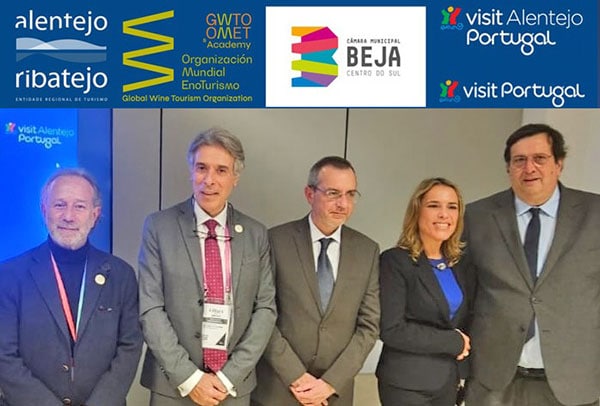
The event was attended by the president of Alentejo Tourism, José Santos, the president of the Global Wine Tourism Organization (GWTO), José Antonio Vidal, the mayor of Beja, Nuno Palma Ferro, the GWTO LatAm Director, Pablo Singerman, the GWTO Portugal Delegate -and president of Enotourism Portugal APENO-, Maria João de Almeida, together with other national and international authorities.
“We are very proud to take another step forward in the recognition of the Alentejo as a enotourism destination committed to a conscious and deeply respectful strategy for our region. In the Alentejo, wine is the most representative product: it is history, it is tradition, and it is identity,” said José Manuel Santos, president of Turismo de Alentejo.
The GWTO Founder and President CEO, José Antonio Vidal, reported that “the GWTO Global Summits are one of the lines of action within the five pillars of the strategic plan, aim to contribute to the destinations positioning and strengthening on the RSS Enotourism international map, both for emerging destinations and for those that are already well established:
- Promotion by organizing events into GWTO MICE area,
- Recognition through the international GWTO Biosphere Certification as an RSS enotourism destination,
- Training in Comprehensive Management of RSS Enotourism, by GWTO Academy in collaboration with local academic institutions,
- Commercialization through the inclusion of enotourism activities on the GWTO global RSS enotourism booking platform ‘EWC EnoWineClub: More than Wines’, and
- Monitoring of destinations and their enotourism resources, contributing data to the ‘GWTO Economic Monitor/Observatory of Global Enotourism’ “.
Set among vineyards, centuries-old olive groves, and wide plains, the Alentejo region welcomes visitors to its wine culture, offering experiences that combine tours, tastings, accommodation, and gastronomy, creating a carefully curate enotourism offering.
MORE INFO: [email protected]
ESP
Alentejo se presenta en FITUR como sede de la III Cumbre Global OMET del Enoturismo RSS 2026
La región portuguesa del Alentejo, reconocida por su filosofía de turismo slow y la calidad de sus vinos, se ha presentado en FITUR como la anfitriona en 2026 de la III Cumbre Global OMET de Enoturismo Responsable, Sostenible y Satisfactorio.
Enoturismo Responsable con el medio ambiente, Sostenible en el tiempo, y Satisfactorio tanto para los visitantes como para los residentes.
El magno encuentro reunirá en el territorio luso a profesionales líderes de todo el mundo, para partipar en la conferencia, en el B2B y en el área expositiva.
Punta del Este (Maldonado, Uruguay) y Yantai (Shandong, China) fueron sedes de las Cumbres Globales OMET en 2024 y 2025, respectivamente.
Beja (Alentejo, Portugal), lo será este año del 31 de mayo al 3 de junio, y será la primera Cumbre Global de la Organización Mundial del EnoTurismo (OMET) organizada en Europa.
Querétaro (México) y Ningxia (China) aportaron sus credenciales para serlo en 2027; y también se han postulado destinos candidatos para ser sede de la Cumbre Global OMET en 2028.
La elección de Alentejo como sede de la III Cumbre Global OMET refuerza su posicionamiento estratégico, basado en un turismo de bajo impacto capaz de conectar a los viajeros con la comunidad alentejana.
Alentejo es una región extensa y principalmente rural. La belleza de su paisaje y la calidad de su patrimonio arqueológico, monumental y arquitectónico, junto con su excelente gastronomía y sus vinos invitan, sin duda, a descubrir la región.
La Feria Internacional del Turismo FITUR ha sido el escenario elegido para poner en valor el modelo del Alentejo como destino enoturístico RSS, basado en la autenticidad del territorio, el respeto por el entorno y la tradición vitivinícola local.
El acto ha contado con la presencia del presidente de Turismo de Alentejo, José Manuel Santos, del presidente de la Organización Mundial del EnoTurismo (OMET), José Antonio Vidal, del alcalde de Beja, Nuno Palma Ferro, del director de OMET para LatAm, Pablo Singerman, de la delegada de OMET para Portugal –y presidenta de Enoturismo de Portugal APENO-, Maria João de Almeida, junto con otras autoridades nacionales e internacionales.
“Estamos muy orgullosos de dar un paso más en el reconocimiento del Alentejo como destino enoturístico comprometido con una estrategia consciente y profundamente respetuosa con nuestro territorio. En el Alentejo, el vino es el producto más representativo: es historia, es tradición y es identidad”, ha señalado José Manuel Santos, presidente de Turismo de Alentejo.
El Fundador y Presidente CEO de OMET, José Antonio Vidal, informó que “las Cumbres Globales OMET son una de las líneas de actuación dentro de sus 5 pilares del plan estratégico, para colaborar con los destinos a su posicionamiento y fortalecimiento en el mapa internacional del Enoturismo RSS, tanto de los destinos emergentes, como de los ya consolidados:
- La promoción con la organización de eventos en el área OMET MICE,
- El reconocimiento a través de la Certificación internacional ‘OMET Biosphere’ como destino enoturístico RSS,
- La capacitación en Gestión Integral del Enoturismo RSS, por OMET Academy en colaboración con entidades académicas locales,
- La comercialización, mediante la inclusión de las actividades enoturísticas en la plataforma OMET de reservas del Enoturismo RSS mundial ‘EWC EnoWineClub: Más que Vinos’, y
- La monitorización de los destinos y sus recursos enoturísticos, aportando sus datos al ‘Monitor/Observatorio Económico OMET del Enoturismo Mundial’ ”.
Entre viñedos y olivares centenarios y amplias llanuras, el Alentejo abre las puertas de su Cultura del Vino al visitante, con experiencias que integran visitas, catas, alojamiento y gastronomía, configurando una oferta enoturística cuidada.
MÁS INFO: [email protected]